Australian businesses are going through every cost line to find savings. Most are skipping one that has risen faster than almost any other since 2020, and is now the easiest to bring down without taking on extra risk.
THE SQUEEZE
Australian business is being squeezed from both ends: costs are still rising while demand is fading. On 3 November the Reserve Bank lifted the cash rate to 4.85%, its fifth hike of 2026 and the highest setting since 2008. The Bank now expects inflation to stay above 3% for the coming year and to reach the top of its target band only in late 2027.
The numbers behind that decision are hard on business owners:
- Inflation: headline CPI ran at 4.3% in the year to September, up from 4.0% in August, with trimmed mean at 3.6% (ABS). Fuel and conflict-related costs from the Middle East are flowing through to almost every input.
- Activity: the RBA describes an economy that is slowing, with housing prices down significantly and growth expected to soften further over the coming year.
- Sentiment: NAB's October survey put business conditions at −2, the weakest since August 2020. Forward orders fell 11 points and profitability sits at −8, more than 10 points below its long-run average (NAB).
- Failures: 14,152 companies entered insolvency for the first time in 2025–26. That is slightly below the prior year's 14,722 but still above the long-term average, led by construction and hospitality (ASIC).
The conclusion for finance leaders is simple. Revenue is harder to find, borrowing costs more, and margin will have to come from the cost base.
THE LABOUR MARKET IS TURNING
The clearest sign of strain is in jobs. Unemployment jumped unexpectedly to 4.9% in October, up from 4.7% and the highest since the pandemic. Economists had expected the rate to hold and 25,000 jobs to be added. Instead, 43,500 people lost work, and the employment-to-population ratio fell 0.3 points to 63.3% (ABS, reported by the AFR).
Redundancies tell the same story. About 65,700 people were made redundant in September, and 174,100 over the past three months. That three-month total is the highest since August 2021, back at COVID-era levels. Well-known employers including Canva, Qantas and Bunnings have announced cuts, and retailers such as David Jones and General Pants have entered voluntary administration.
The RBA is choosing to fight inflation anyway. Minutes of the November meeting show the six members who voted to hike judged the risk of doing too little on inflation to be greater than tightening too far. The three dissenters warned of a "materially sharper downturn". October's 4.9% is already above the 4.7% the Bank forecast for the end of this year, and it expects unemployment to reach 5.1% by the end of 2028.
For employers, the picture is uncomfortable in both directions. Demand is weakening, yet wage growth just hit a near three-year high in the September quarter, driven in part by award rises and public sector agreements. Labour costs are rising just as revenue gets harder to win.
EVERYONE IS CUTTING
Cost reduction is back at the top of the CFO agenda. Ai Group's 2026 outlook found that twice as many businesses expect input and energy costs to rise as expect to lift their own prices. That 39-point gap is the widest the survey has recorded, suggesting much of the cost increase will be absorbed on the balance sheet rather than passed on.
The usual playbook follows: hiring freezes, deferred capex, renegotiated leases, energy contracts put out to tender, software licenses rationalised. These are worthwhile, but most are slow, disruptive, or both. Cutting headcount affects capacity and culture. Deferring investment stores up problems for the next cycle. Energy and rent are often locked into multi-year contracts.
What CFOs want are savings that land quickly, need little internal effort, and leave the business no weaker. One cost line fits that description better than any other right now, and it rarely makes the list.
THE BLIND SPOT
Insurance is one of the larger costs most businesses carry, and the one that has grown fastest. AMP's Small Business Cost Pressure Index weights insurance at 5% of a typical small business's costs, level with electricity and interest. Only wages (50%), rent (11%), other overheads (11%), fuel (7%) and other financial services (7%) weigh more. That makes it a top ten cost for almost any business. Leave aside wages and the catch-all overheads line, and it is a top five one.
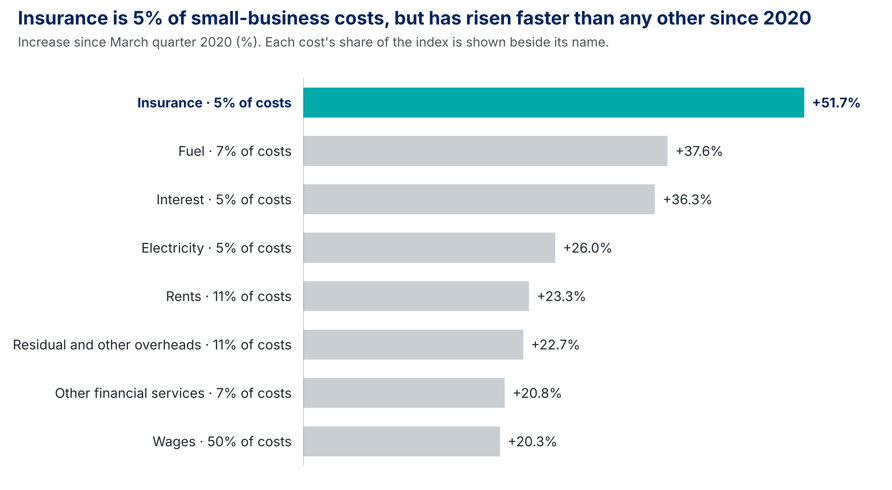
Source: AMP Bank GO Small Business Cost Pressure Index, August 2026 · index weights and unweighted rises since March quarter 2020
In our experience, the share is often higher for mid market firms. Property, fleet, professional indemnity, D&O, cyber and trade credit add up quickly. According to KPMG, Australia's general insurance market now writes more than $71 billion in premium a year.
Business owners feel it. In Canstar's survey of more than 2,000 small business owners, insurance ranked as the third-biggest cost pressure, behind energy and fuel and ahead of rent. In a 2025 COSBOA and Commonwealth Bank study, around 45% of owners named insurance as a significant pressure, just behind tax and wages.
Yet in the finance function, insurance gets less attention than costs a fraction of its size. In our experience at SRG, there are four reasons:
- It arrives once a year. Renewal lands a few weeks before expiry, competes with month-end and budgets, and gets approved to avoid a lapse.
- It looks fixed. Many CFOs treat the premium as a price set by the market rather than a number they can negotiate.
- It feels risky to touch. Cutting insurance sounds like cutting protection, so the safe choice is to roll it over.
- It is hard to benchmark. Unlike energy or telco, there is no comparison site for a commercial program, so nobody knows what "good" looks like.
- Ask for the numbers. Total premium by policy over the last three years, and what the market has done in the same period.
- Refresh the inputs. Update revenue, wages, asset values and contracts before the submission goes out.
- Set the brief. Agree what must not change (limits, key covers) and where you have room (deductibles, structure).
- Go to market. Ask your broker to approach several insurers and show you every response, not just the recommendation.
- Compare like for like. Judge quotes on wording, limits and exclusions as well as price.
- Lock it in. Where the market allows, use longer-term agreements to hold today's pricing.
The result is a large, fast-growing cost that is too often renewed on autopilot.
THE WINDOW
The insurance cycle is now running the opposite way to the rest of the economy. While rates, fuel and wages push other costs up, commercial insurance prices across most major lines are falling, and have been since 2024. SRG expects the commercial market to keep softening over the coming year, forecasting average premium reductions of around 11% for commercial property and 9% for public liability. We forecast the insurance outlook for the next 12 months:
|
Line |
Forecast change in average premium |
|
Commercial property |
−11% |
|
Public liability |
−9% |
|
Financial and professional lines |
−5% |
|
Cyber |
Reduction offset by +4% premium growth |
Source: SRG Analysis
The causes are well understood: insurers are profitable, capital is plentiful, reinsurance costs have eased and investment returns are higher. Local brokers report the same picture across property, liability, financial lines and cyber, with insurer appetite broadening for well-run risks.
There are two caveats. First, a falling market rate does not reach every client automatically. Exposure growth, claims history and how a program is built still decide where an individual business lands. A business that simply rolls its renewal over may see a small reduction, or none, while the market moves 10–15%. Second, soft markets do not last. The 2019–2023 hard market showed how fast conditions can turn, which is why the time to lock in better terms is now.
SAVINGS WITHOUT NEW RISK
The goal is to pay less for the same protection, or better protection, not to buy less of it. Cutting limits or dropping covers to hit a budget is a false economy: one uninsured claim can wipe out years of savings. In a soft market, there is plenty to gain without going near that line.
|
Lever |
How it saves |
Risk added |
|
Take the program to market |
Tests the incumbent's price against insurers competing for good risks, instead of accepting a renewal offer |
None |
|
Check declared values |
Current revenue, wage and asset figures make premium reflect the actual exposure (which can lower or raise it) and guard against underinsurance |
None |
|
Remove overlaps |
Finds cover bought twice across entities, policies or contracts |
None |
|
Consolidate and align |
Combines policies, aligns renewal dates and uses package or multi-year deals to lock in today's rates |
None |
|
Present the risk properly |
A clear underwriting submission with risk controls and claims data can earn better pricing than a form refreshed from last year |
None |
|
Improve the wording |
Uses insurer appetite to broaden cover, lift sub-limits or add cyber for the same or a lower premium |
Lower |
|
Calibrate deductibles |
Sets excesses to match the balance sheet's real capacity to retain small losses |
Only within agreed tolerance |
|
Ask how your broker is paid |
Fee and commission transparency shows whose interest a falling premium serves |
None |
None of these require a business to accept more risk. Most need one thing a busy finance team rarely has at renewal: time to prepare.
BEFORE YOUR NEXT RENEWAL
Start 90 to 120 days out, not three weeks. In our experience, that is the single change that turns renewal from a formality into a saving. A practical sequence for CFOs:
In a year when every cost line is under review, insurance deserves a seat at the table. It is a top ten cost for most businesses, it has risen faster than almost anything else since 2020, and the market is now moving in the buyer's favour. Few other savings are this large, this quick, and this free of trade-offs.
Difficult. Done Well. If you would like a no-obligation review of your program ahead of your next renewal, talk to the team at Specialist Risk Group.
SOURCES
- RBA, Statement by the Monetary Policy Board, 3 November 2026
- ABS, Consumer Price Index, September 2026
- ABC News, unemployment September 2026
- AFR, RBA minutes reveal dissenters' concern over sharper downturn
- AFR, wages up 1.1% in September quarter
- NAB Monthly Business Survey, October 2026
- Accountants Daily, ASIC insolvency statistics FY2025–26
- Ai Group, Australian Industry Outlook 2026
- AMP Bank GO Small Business Cost Pressure Index, August 2026
- Canstar, small business survey 2026
- insuranceNEWS, COSBOA and CommBank report
- KPMG, General Insurance Insights 2026
- Insurance Business, Australian market soft through H1 2026
- Insurance Business, Pacific rates fall 12%
Author