Australia’s proposed Capital Gains Tax (CGT) reforms will force many people to formally value their collections for the first time. What that process reveals about their insurance cover may be the bigger shock.
It is hanging on the dining room wall, sitting in a climate-controlled cellar, or locked in a safe.
Fine art, vintage wine, luxury watches, classic cars, and rare jewellery have long held a unique place in private wealth. Driven by passion, taste, and inheritance, these collections are highly valuable assets. Yet they are rarely treated as such. They are discussed in terms of emotion, not economics.
But a looming tax reform is about to force a harsh financial spotlight onto these quiet assets. For anyone who has accumulated valuable physical assets over the years, the question of whether those assets are adequately insured has never been more urgent.
The looming valuation trigger
The Federal Government’s latest budget has proposed a structural reset for capital gains tax (CGT). From 1 July 2027, the existing 50 per cent CGT discount will be replaced with an indexation model, alongside a new 30 per cent minimum tax on net capital gains. Crucially, the reforms extend to assets acquired before September 1985 – assets that have sat entirely outside the CGT regime for four decades. Pending legislation, the changes are expected to take effect from 1 July 2027.
For anyone who holds valuable physical assets, this is a critical moment. A formal valuation of those assets as at 1 July 2027 will be required under the transitional rules. The ATO will provide tools to assist, but for unique or illiquid assets – fine art, classic cars, rare wine – a professional valuation is the only credible approach.
However, establishing a formal tax position triggers a much broader, and potentially more dangerous, question:
If I now know exactly what this collection is worth, is it properly insured?
The documentation gap
The paperwork rarely matches the passion. Purchase receipts go missing. Valuations are years out of date. Assets are scattered across multiple properties and storage facilities.
In a rising market, this problem compounds silently. For example, the owner of an Emily Kam Kngwarreye artwork acquired in the primary market for between $8,000 and $10,000 in 1992 could now realise more than $1.19 million at auction today, following record sales for her work.
Because collections were neither being sold nor divided, the absence of updated valuations did not seem to matter. The impending CGT changes, however, are likely to bring that era of complacency to an abrupt end.
Tax value is not insurance value
When valuing these assets, people frequently make one fundamental, costly mistake: assuming all valuations are the same.
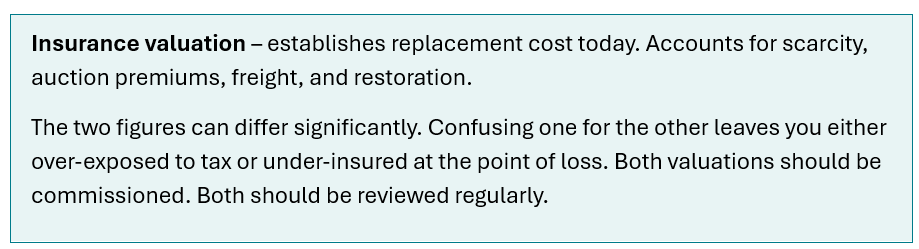
A tax valuation is concerned with market value at a specific point in time. It is designed to establish a cost base or a future capital gains position.
These two numbers can diverge wildly. An insurance valuation must account for the cost of sourcing a replacement, extreme market scarcity, auction buyer premiums, specialist freight, and restoration costs.
Using an old insurance schedule to justify a tax position is inadequate. Conversely, relying on a conservative tax valuation to set your insurance limits is financially dangerous.
 Our LeadersIntroducing the people driving our company's success, get to know more about their backgrounds, expertise and roles within the company.
 Our TimelineWhere did it all begin? SRG was launched in 2019, but the story didn’t begin there!
 PlatformAll teams and businesses are supported by the SRG Platform, which is a system of specialist teams that help shape our processes and best practice.
 About Us
 Training and DevelopmentWe have a reputation for longevity when it comes to upskilling our colleagues. Here are just a few of our initiatives that have helped them take the next step in their careers.
 CareersReady to take the next step and join us on our journey? Find career opportunities and information about what it’s like to work as part of the team.
 Social GalleryWe talk a lot about building a company we’re proud to tell our family and friends about, but don’t take our word for it! Dive into the world of SRG and discover the colleagues making that idea a reality.
 Acquisition NewsFind out more about the brilliant and inspiring specialist companies joining our journey as it happens.
 Colleague FocusWhat is working in insurance really like? Hear the career stories of our valued colleagues and their views on this evolving industry.
 Press ReleasesKeep up to date with all of our important announcements including new leadership appointments and key milestones.