
What corporate leaders should do when the window between disclosure and attack is measured in hours
A vulnerability event that moved at machine speed
PHP is a server-side programming language widely used to build websites and web applications. It runs behind platforms such as WordPress, Drupal and Joomla. As a result, organisations may depend on PHP across public websites, customer portals, internal tools and third-party products without realising how widely it is used. W3Techs reported that WordPress was used by 39.6% of the websites in its survey on 25 October 2026. [1, 5, 7]
On 21 October, PHP released fixes for two critical security flaws, CVE-2026-109618 and CVE-2026-109619, commonly known as PHP2Shell. Both received a severity score of 9.2 out of 10 under CVSS v4.0. In practical terms, a specially crafted web request could allow an attacker to run code on a server without logging in or expose information held in the server’s memory. The level of risk depends on the PHP version and how it is set up. PHP says the greatest risk is to servers using Apache mod_php, although PHP-FPM, php-cgi, FrankenPHP and LiteSpeed are also affected. [1, 4, 5, 6, 11]
How it affects your organisation
Three risks to assess now
|
Risk |
What it could mean for your organisation |
|
Remote takeover |
A successful exploit could allow an attacker to run code with the privileges of the web-server account. Depending on the environment and any additional access gained, this could lead to service disruption, information theft or attempts to reach connected systems. |
|
Data exposure |
Some attack paths may expose information held in PHP worker memory. Depending on what the affected process has handled, that information could include credentials, access tokens or API keys. |
|
Business disruption |
Organisations have reported taking websites and online services offline as a precaution while patches were applied and tested. Those precautionary shutdowns should not be read as evidence that the organisations were successfully compromised. [1, 8, 9] |
The disclosure accelerated attacker activity
Attack activity increased rapidly around the public announcement. Amazon Threat Intelligence reported that its MadPot honeypot recorded an exploitation attempt on 17 October, four days before public disclosure, followed by more attempts on 21 October. Amazon said it was still analysing the activity and could not confirm whether those attempts would have succeeded against real systems. Cloudflare separately reported attack traffic targeting customers and changing payloads intended to bypass protections. Public sources differ in how they characterise the scale and success of exploitation; observed attempts should not be treated as confirmed breaches. [2, 3, 4, 12]
The speed of exploitation turns a technical alert into an immediate business decision. Leaders may have to choose whether to restrict or suspend a critical service before there is proof of compromise. [8, 9]
The operating assumption has changed: for a critical vulnerability exposed to the internet, the response window may be measured in hours rather than in the next scheduled patching cycle. Amazon reported that AI-assisted analysis is lowering the cost of turning patches or advisories into working exploits, allowing more actors to move quickly once technical details become available. Delay can increase exposure, but an organisation’s actual risk depends on whether vulnerable systems are internet-facing, reachable and effectively mitigated. [2, 3]
Why this belongs beyond the security team
Risk leaders: connect the technology map to the risk register. PHP may sit beneath a customer portal, an internal tool, a supplier platform or a third-party appliance. A credible response starts with visibility: which business services depend on PHP, which are internet-facing, which vendors control the runtime, and which services would matter most if unavailable or compromised? The risk register should tie those dependencies to revenue, customer data, contractual commitments and critical operations.
CFOs and business leaders: price the interruption, not only the fix. Costs may include taking services offline, incident response, forensic review, customer notification, lost trading, contractual exposure and regulatory work. Pre-agreed authority for emergency remediation matters, because a team waiting for approval is losing time.
Operations and technology leaders: treat patching as a service decision. PHP published fixed upstream releases 8.5.12, 8.4.27, 8.3.36 and 8.2.35 for these two vulnerabilities. Hosting companies, operating-system distributors and appliance vendors may issue equivalent fixes under different version numbers. PHP 8.1 and earlier are outside regular upstream support, although PHP published limited source backports for 7.4, 8.0 and 8.1 and some vendors may provide supported packages. Updating WordPress, another content-management system or a plug-in does not by itself fix a vulnerable PHP runtime. [1, 3, 4, 5, 6, 10, 11, 12]
Insurance and legal teams: preserve the claim position. Review notification and cooperation requirements under applicable cyber policies, incident-response retainers, customer contracts and regulation, which vary by policy wording and jurisdiction. Engage legal counsel, insurers, brokers and approved response providers in accordance with the relevant arrangements. [4]
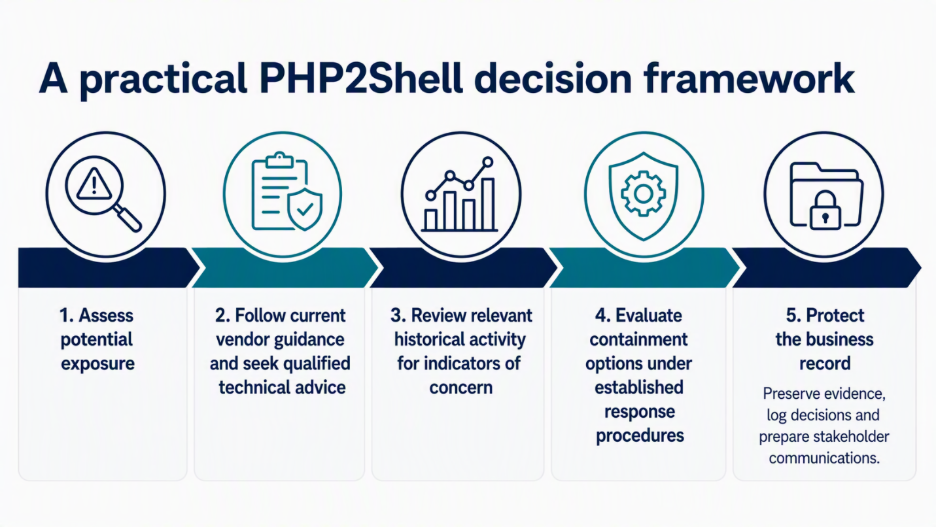
A practical PHP2Shell decision framework
The framework below presents five coordinated decision areas for leaders: assessing potential exposure, following current vendor guidance and qualified technical advice, reviewing relevant historical activity, evaluating containment options under established response procedures, and protecting the business record.
The leadership lesson
PHP2Shell shows why vulnerability management cannot be treated as a routine technical queue. Attacker activity may begin before public disclosure, and a standard seven- or 30-day remediation target may be too slow for a critical flaw exposed to the internet. [2, 8, 9]
Resilient organisations will not rely on perfect foresight. They will know their dependencies, give teams authority to act, maintain alternatives for critical services and connect cyber response to continuity, communications, legal and insurance processes. The question is no longer whether the security team can apply a patch. It is whether the organisation can make a sound business decision before the window closes. [2, 6, 8, 9]
This article reflects publicly available information reviewed on 26 October 2026. It distinguishes reported exploitation attempts from confirmed compromise where the cited sources do so. The situation, exploit assessments and vendor guidance may change. This is general information only and is not legal, insurance, risk-management or technical advice. It does not establish that any organisation has been compromised or is legally liable. Readers should verify current vendor advisories and obtain advice for their circumstances. The publisher should obtain legal and technical review before external publication.
Supporting sources
- PHP2Shell research and remediation overview — vulnerability mechanics, affected releases and fixed versions.
- Amazon Threat Intelligence: exploitation prior to public disclosure — MadPot observations, timeline and response guidance.
- Cloudflare: protections against the PHP2Shell vulnerability — observed attack traffic and web application firewall mitigations.
- Sophos PHP2Shell advisory — affected environments, remediation and investigation guidance.
- Vercel PHP2Shell security bulletin — WAF coverage, limitations and patching guidance.
- NCSC-NL PHP2Shell operational information — operational guidance and affected-software tracking.
- W3Techs WordPress usage statistics — WordPress share of websites measured on 25 October 2026.
- The Straits Times: Governments, companies take websites offline over PHP flaws — examples of precautionary service suspensions across governments and organisations.
- The Business Times: Millions of hacking attempts as companies, governments rush to patch PHP flaws — global service disruption, patching activity and reported attempt volumes.
- PHP supported versions — official support lifecycle, including PHP 8.2 security support through 31 December 2026.
- Google Cloud: responding to core PHP vulnerabilities — vulnerability impact and updated monitoring, patching and remediation guidance.
- Sansec PHP2Shell analysis — exploitability qualifications and guidance for patched and legacy PHP environments.
Author