
A supplier can be dependable and a site fully operational, yet a decision across the border can still interrupt the flow of energy. Indonesia’s reduction in gas exports to Singapore puts a practical question on the table: were your contracts, continuity arrangements and insurance built for that kind of disruption?
A limited reduction, a wider test
CNA reported that Indonesia began reducing gas exports to Singapore on 24 October, with Indonesia’s upstream regulator saying the move was intended to prioritise domestic electricity needs. Singapore’s Energy Market Authority put the reduction at less than 2% of total daily gas demand and said contingency plans were in place, with Singapore GasCo ready to import more liquefied natural gas (LNG) [1].
A resilient national grid does not settle the question for every business. The Star’s Bloomberg report and Malay Mail noted that Gas Supply had reported affected customer deliveries following temporary reductions from its Indonesian supplier [4][5]. The business-level test is closer to home: what can keep running, what would cost more, and which losses would remain yours to carry?
The contract question remains separate. CNA reported Indonesia’s position that the cuts were within contractual limits and Singapore’s welcome for the clarification that suppliers would honour their contracts [2]. CNA also reported Prime Minister Lawrence Wong’s expectation that commitments be honoured and that the importer would protect its rights [8]. Those are reported positions, not findings of liability. Check the contract and the policy separately. A right to seek a contractual remedy does not, on its own, establish that the loss is covered by insurance.
“A supply disruption does not need to damage your premises to put pressure on your balance sheet.”
Political risk: start with the event, not the label
Political risk insurance is worth understanding, but not treating as a blanket answer. It may protect an insured investment or contract against specified events: expropriation, currency conversion or transfer restrictions, political violence, or defined government interference with contractual rights [3]. The starting point is the event the wording covers - not the fact that a government is involved.
Contract frustration cover can be relevant to some cross-border exposures. Certain products address specified government actions or cancellation or non-renewal of import or export licences [3]. But the routes to a claim differ. MIGA’s breach-of-contract product, for example, links cover to interference with dispute resolution or non-payment of an award, subject to specified conditions [9]. These examples show why the wording matters; they do not confirm cover or availability for this gas reduction.
A supply reduction is not, by itself, a trigger for payment. Establish what interest is insured, which event is covered and what loss follows. Then check the contracting party, waiting periods, evidence, exclusions, limits and any requirement to pursue remedies. A local gas customer should not assume it has the same insured interest as the cross-border importer. Timing matters too: do not assume new cover can pick up an already announced disruption. Disclosure and individual underwriting assessment remain necessary.
Other covers: test the loss against the wording
Start with the financial consequence. Lost production, damaged plant and an unpaid invoice are different problems, even if they begin with the same interruption. Put the same scenario through each relevant policy. The gaps are as important as the cover.
- Property and business interruption: will lost income be covered without damage? If supply is reduced but nothing is damaged, do not assume lost income is covered. Check any utility interruption extensions and whether they still require physical damage, alongside exclusions, limits and any waiting period.
- Contingent business interruption: what if the disruption starts with a supplier? Ask your broker to check whether the policy covers the particular supplier disruption, including the insured causes, supplier scope, any physical-damage requirement and any specific non-damage extensions. Do not assume that a government-directed supply reduction is covered.
- Trade credit and non-delivery: is the risk non-payment or non-performance? Trade credit insurance generally addresses insured customer debts unpaid because of insolvency, prolonged default or, where included, specified political events [10]. It is not a general guarantee of supplier delivery. For advance payments or undelivered goods, ask whether specialist pre-delivery or contract frustration insurance covers the particular transaction and cause of loss; do not assume ordinary trade credit cover does.
- Machinery, property and stock: what if physical damage occurs? As a hypothetical scenario, a power disturbance might damage equipment or refrigerated stock. A claim would require the cause and resulting damage to fall within the relevant policy, including any machinery breakdown or deterioration-of-stock extension. This article does not establish that such damage has occurred, and fuel shortage alone should not be assumed to trigger cover.
- Project and construction cover: what if completion is delayed? Conventional delay-in-start-up cover generally requires delay caused by insured physical damage under the associated material-damage policy [11]. A supply restriction causing delay without such damage should not be assumed to qualify. Contractual penalties require their own legal and coverage assessment; they are not automatically covered by delay-in-start-up insurance.
- Directors and officers, and legal expenses: what if a claim or dispute follows? These covers should not be presented as compensation for lost production. If a claim against an insured director or officer, or a contractual dispute, arises, seek advice on whether the relevant policy responds. Insured parties, definitions of claims, exclusions, notification requirements and any requirement for insurer consent must be checked.
Risk, Finance and Operations: work from the same scenario
Risk managers need the dependency map. Finance needs the cost of a short interruption and a longer one. Operations needs workable alternatives, not just a list of suppliers. Procurement and Legal need to know the rights, notice requirements and remedies in the contracts. Bring those views to your broker together, then give the board one plan showing what is insured, what can be managed and what needs funding.
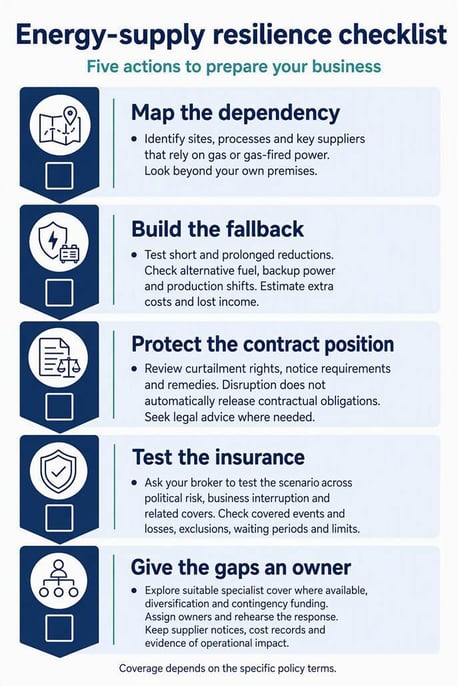
Energy-supply resilience checklist
This checklist provides a framework for assessing readiness for an energy-supply disruption. It brings Risk, Finance, Operations, Procurement and Legal together to review dependencies, alternative arrangements, contractual rights and insurance gaps, and to establish clear responsibilities for responding to changes in supply.
Insurance supports the plan—it does not replace it
The longer-term question is supply choice. Malay Mail reported that Indonesia was considering not renewing gas export contracts with neighbouring countries; that report does not establish that non-renewal has been decided [7]. CNA and Malay Mail also highlighted Singapore’s investment in LNG terminals to diversify supply [6][8]. For businesses, this suggests planning for temporary shortfalls and future changes in supply arrangements. Ordinary expiry without renewal should not be equated with an insured licence cancellation or contract repudiation; any coverage assessment depends on the specific circumstances and terms.
Insurance can help absorb an insured financial loss. It cannot turn the supply back on or repair a contract that leaves the business exposed. Where cover is unavailable or not cost-effective, put the gap into the operating plan: alternatives, contingency funding and responsibilities agreed before pressure builds.
Notification belongs in that plan too. Speak to your broker early, follow each relevant policy’s requirements and preserve the evidence. Waiting for the final loss figure should not mean missing a notification deadline.
Do the testing before the next decision
This is not a forecast of an energy crisis. It is a reason to test an exposure that crosses contracts, operations and finance. Political risk insurance may have a place, but only alongside a clear understanding of what it covers and what it leaves with the business. The useful outcome is a joined-up response, not a longer list of policies.
If supply changed tomorrow, who would act, what would keep running, and which losses would your business carry?
This material is for general information only and is not insurance, legal, financial or engineering advice. News statements are attributed to the cited reports and are not independent findings of fact or liability. No conclusion is drawn about political motive, contractual breach or entitlement to compensation. Coverage descriptions are illustrative: the insured interest, facts, policy wording, conditions, exclusions, limits and applicable law determine any response. Product availability and suitability require individual assessment. Sources were reviewed on 30 October 2026 and developments may change. Obtain advice appropriate to your circumstances.
Sources
1. CNA, “Indonesia reduces gas exports to Singapore in order to ‘safeguard reliability’ of domestic supplies”, 24 October 2026. Accessed 30 October 2026.
2. CNA, “Indonesia says gas export cuts to Singapore within contractual limits, pledges to honour obligations”, 26 October 2026, updated 27 October 2026. Accessed 30 October 2026.
3. MSIG USA, “Political Risk and Contract Frustration Insurance”. General product reference, not confirmation of cover or availability for this risk. Accessed 30 October 2026.
4. The Star (Bloomberg), “Indonesia begins trimming pipeline gas exports to Singapore”, 26 October 2026. Accessed 30 October 2026.
5. Malay Mail, “Singapore shrugs off Indonesian gas cuts, urges importers to take legal recourse”, 25 October 2026. Accessed 30 October 2026.
6. Malay Mail, “Singapore vows to protect contractual rights over Indonesia’s gas export cut; PM confirms nuclear feasibility study”, 25 October 2026. Accessed 30 October 2026.
7. Malay Mail, “Singapore’s pipeline gas from Indonesia under question as Jakarta weighs not renewing contracts”, 23 October 2026. Accessed 30 October 2026.
8. Channel NewsAsia, “Singapore expects all parties to honour commercial gas contracts, says PM Wong after Indonesia cut exports”, 25 October 2026. Accessed 30 October 2026.
9. MIGA, “Breach of Contract”. Product-specific reference, not a description of all political risk policies. Accessed 30 October 2026.
10. Allianz Trade, “Trade credit insurance FAQs”. General coverage reference; local terms and availability may differ. Accessed 30 October 2026.
11. Swiss Re, “DSU – Key UW Considerations & Strategies to Claims Mgmt”, 22 August 2019. Technical reference for conventional delay-in-start-up cover, not current market availability. Accessed 30 October 2026.
Author